I spent days preparing my workshop. The night before, I threw most of it away.
The night before my talk on AI and leadership, a dinner conversation made me rebuild everything overnight with AI. The real lesson wasn't the technology, it was the people who showed up at midnight. Agentic AI for decision makers, from solo founders to enterprise leaders.
By Zara Hunter, Founder of Eduk8agentic · 8 min read · Last updated
I spent days preparing my workshop. The night before, I threw most of it away.
I don't say that for effect. I mean it literally. And what replaced it taught me more about leadership in the age of AI than the talk I'd so carefully built.
Here's the whole story, including the system at the centre of it.
In this article: The command centre I built · The pains it solves · Why you can trust it · The dinner that changed everything · The choice · I didn't do it alone · What happened in the room · The real lesson
What I set out to show: a command centre for the CEO
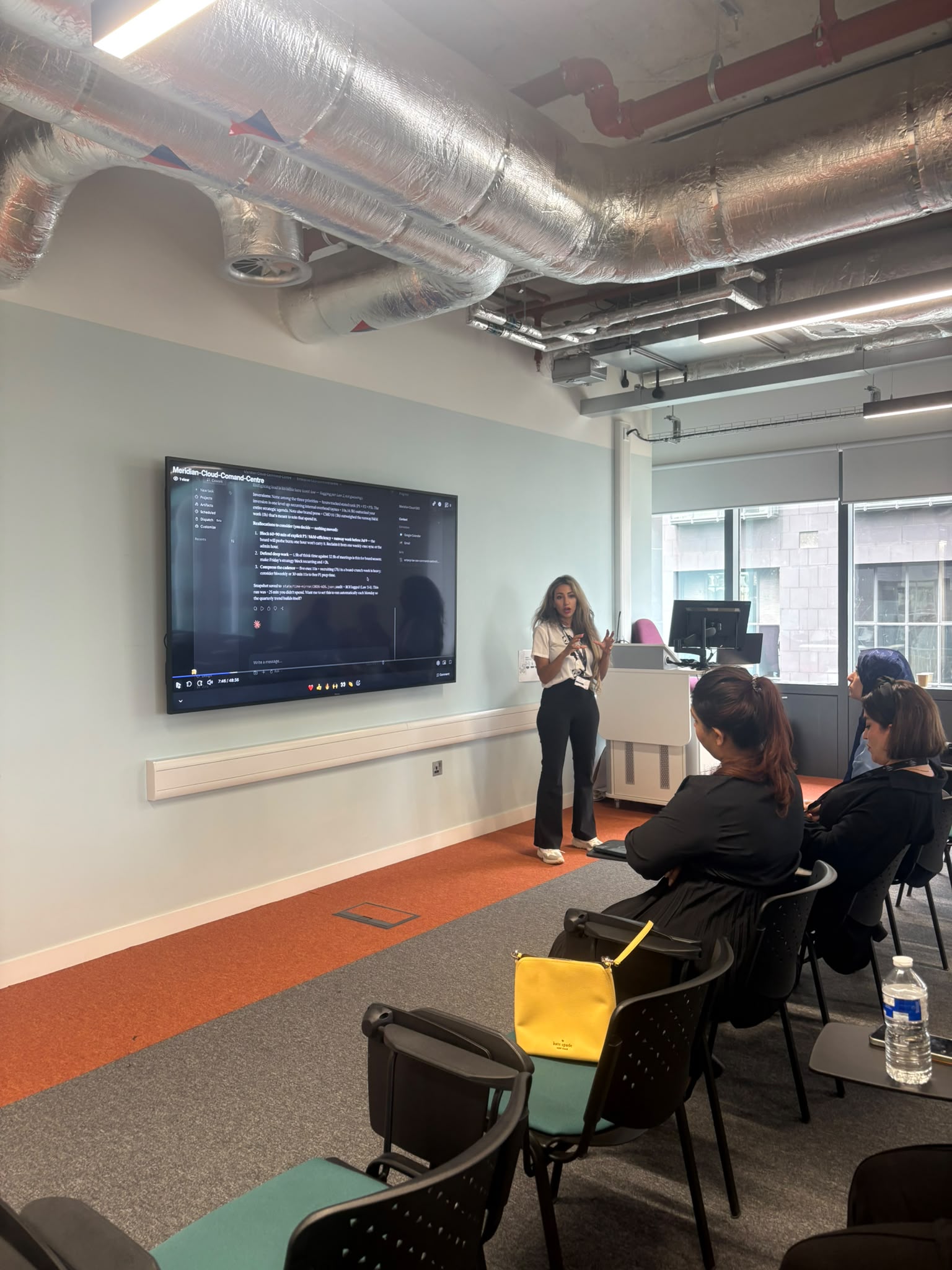
My centrepiece was something I believe in deeply: an agentic CEO command centre. Not a chatbot bolted onto a dashboard. A governed operating system for the person running the company.
The premise is simple. A CEO is the most information-starved person in their own business. The numbers live in a dozen systems. The important signals are buried under noise. And every quick question turns into a two-day fire drill. So I built a system whose whole job is to make the CEO the best-informed, fastest-deciding, least-overloaded person in the room, without ever taking away their control.
Most executive AI fails here, and it's worth being honest about why. It rarely fails on capability. It fails on trust. One confident, wrong number in front of a board, and the tool is finished. So this one is built the other way round: trust first. I'll come back to how. First, what it actually does.
The pains it's built around, and what it does about each
I designed it against the problems leaders genuinely lose sleep over. Not hypothetical ones. These pains are decades old. What's new is that we can finally close them fast.
"I can't get a straight answer on our own numbers."
Sales says one figure, Finance says another, the board deck says a third. Reconciling them is the single most common data headache at the top.
The command centre settles it once. Each key metric is defined a single time: its meaning, its source, its formula, its owner. So there's one agreed number, not three. When two systems genuinely disagree, it doesn't pick a winner quietly. It shows you both and flags the conflict. Then it delivers a daily briefing in under a minute, with every figure cited, answering the core question: how are we doing, what changed, and what does it imply?
"Too much comes at me, and the important things get buried."
Hundreds of emails, updates, and requests a day. Only a handful actually need the CEO.
The system triages the whole firehose by strategic weight. The routine, low-stakes items it drafts a response to and holds for a yes. The high-stakes ones it turns into a short decision memo, with options, trade-offs, and a recommendation, so the call takes minutes instead of a morning. It hands the CEO leverage, not another to-do list.
"My time drifts away from what I said mattered most."
Every leader sets priorities. Then the calendar fills with everything else, and months pass before anyone notices the gap.
The command centre holds up a mirror. It compares where the hours actually went, across calendar and inbox, against the stated priorities, and shows the gap plainly. Customer time, your number-two priority, got starved. Internal meetings ate the week, three to one. Nobody had to notice manually. The system did.
"Good plans quietly stall, and I find out too late."
Strategy gets set, then drifts in the doing. Knowing which initiatives are on track, which are stuck, and why, in real time, is one of the hardest parts of the job.
It keeps a live view of execution: each priority, the work under it, what's healthy, what's stalled, and the single lever each stuck item needs to move again, traced back to a real signal, not a gut feel. Problems surface while they're still fixable, not in the quarterly post-mortem.
"Answering what if takes a week."
What happens to cash and runway if we lose our biggest customer? If input costs jump 10 percent? By the time someone builds the spreadsheet, the moment's gone.
The command centre runs the scenario against the real numbers in seconds, showing the impact on growth, cash, and runway, and flags the early-warning signs to watch. It also keeps a continuous eye on the market and competitors, folding anything that matters into the briefing, so market-sensing is always on rather than a project.
"Board and investor prep eats my weekends."
Pulling numbers from everywhere, building charts, writing it up, triple-checking every figure, every quarter.
It assembles a full board pack or investor update from the reconciled numbers, cited, against plan, with the honest lowlights included, and hands it over as a finished draft to review, with the decks to match. Crucially, it never launders a disputed number into a confident one. The work that used to eat a Saturday is ready in minutes.
Why you can actually trust it
None of that matters if a leader can't rely on it. So the whole system runs on four habits it never breaks. These are the responsible innovation part, made real.
It asks before it acts. Reading, analysing, and drafting are free and safe. Anything that leaves the building or can't be undone, whether sending, booking, paying, or publishing, stops and waits for a yes. It proposes, and the leader decides.
Every number shows its receipts. Source, as-of date, and confidence, every time. A confident wrong number is the one thing that destroys trust, so it simply won't produce one.
Everything is on the record, with an off switch. Every meaningful action is logged, and a single command freezes all of its automatic behaviour instantly.
It proves its own worth. Every hour saved and decision accelerated is recorded, so you can always answer the honest question: is this actually paying off?
Capable, but answerable. That combination is what turns AI in leadership from a risk into something you can genuinely lean on.
I was ready to show all of it.
The dinner that changed everything
Then, at the gala dinner the night before, I got chatting with another speaker.
Between courses, they mentioned they use an interactive learning app to keep their audience engaged. It wasn't how I worked. I'm not an academic, and I don't run workshops that way. When I run a session, people are usually on their laptops, building alongside me.
Not this time. This audience wouldn't have laptops. My whole hands-on style was suddenly off the table. And the honest advice was blunt: don't try a brand-new platform for the first time, live, in front of a room.
So there I was, back in my room, with a real problem and one night to solve it.
The choice
I could play it safe: deliver the talk as slides and hope the room stayed with me. Or I could do the exact thing I was about to stand on a stage and preach.
I chose the second. I threw out the safe version.
Instead of waiting, or buying, or wrestling with someone else's tool, I built my own. A small engagement app, with word clouds, live polls, and results building on screen, made with AI, overnight.
But here's the part I can't stop thinking about.
I didn't do it alone
At midnight, I reached out to my community, the people I teach. And they came.
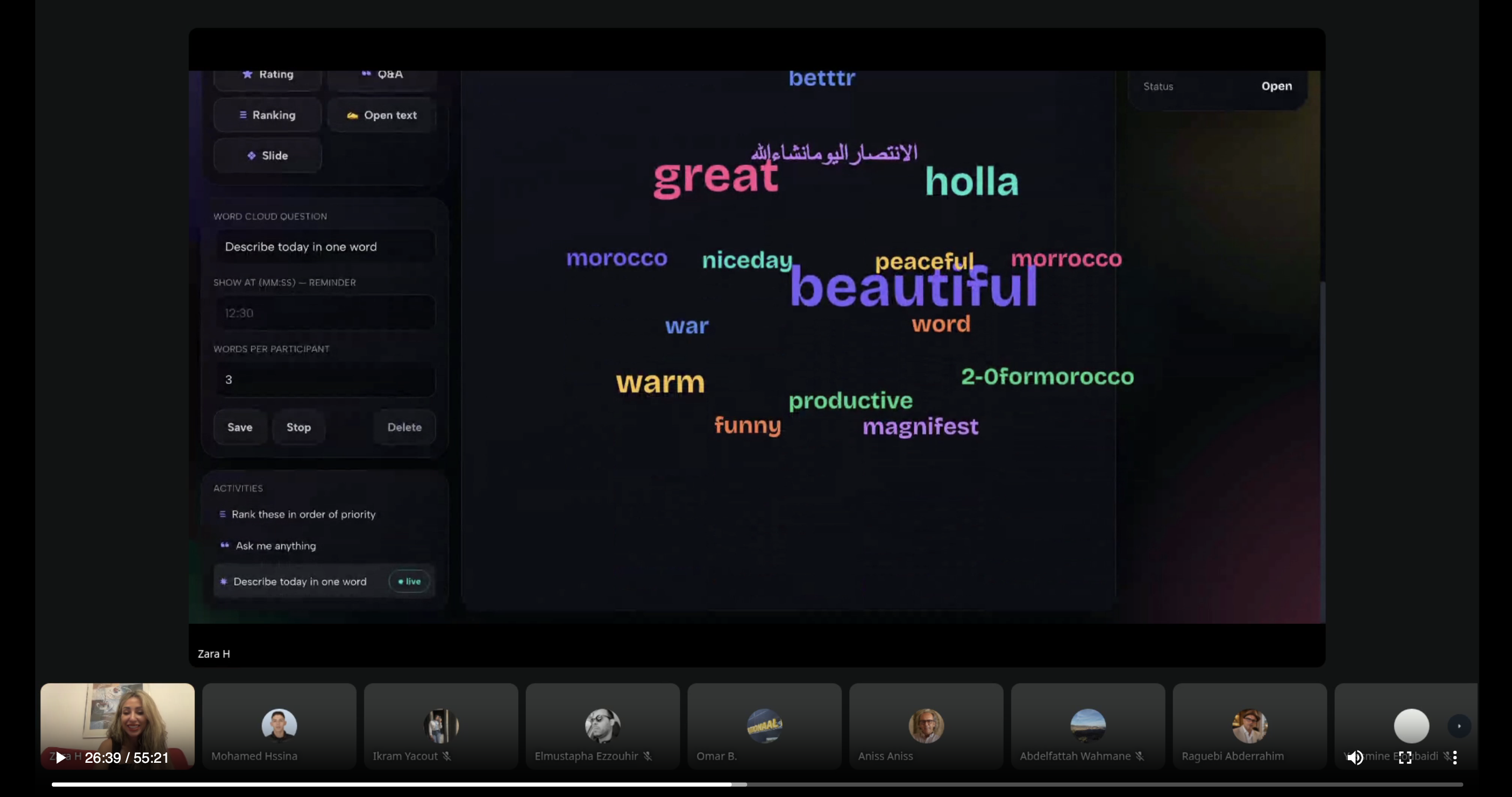
One by one, they showed up to test it, break it, fix it, and make it real. We were laughing at 1am over an app that hadn't existed a few hours earlier.
Think about what that actually is. You can build a lot of things quickly now. You cannot fast-build that. You can't conjure people who show up for you at midnight because you once showed up for them. That isn't one evening of AI. That's years of trust.
What happened in the room
The next day, the whole room used our app all session. And near the end, I told them where it came from.
Then something even better happened. When one of the attendees asked whether the same approach could work for their own challenge, we didn't just talk about it. In the last twenty minutes of the session, together, we built the skeleton of a similar version. Live. In front of everyone. From a question to a working shell, in twenty minutes.
That's the real point, and it isn't a fluke you pull off once at midnight. It's repeatable. In daylight. With a room full of people.
The lesson that wasn't about the app
Here's what I keep coming back to.
Yes, AI has collapsed the distance between a leader spotting a problem and solving it. No budget request. No six-month roadmap. No waiting for permission. Leaders can move at a speed that used to be impossible, and I stand by every word of that.
But the deeper truth is quieter. AI closed the gap between my problem and a solution. My people closed the distance between me and doing it alone.
The technology moved fast. The ecosystem is what made the speed mean anything.
And notice who wins in this new world. It isn't the most technical person in the room. It's the leaders, the ones who can spot a real problem, orchestrate a solution, and refuse to wait. Leadership in the age of AI was never about learning to code. It's about knowing which problem is worth solving, and having people around you who will build it with you at midnight.
So here's my honest belief about where this is heading. Agentic AI shouldn't replace human connection. Its highest purpose is to empower it, to give communities like mine more time, more reach, and more room for the deeply human things only people can do.
I walked in planning to talk about leadership in the age of AI. I walked out reminded that in any age, the people who show up for you are the whole game.
When you needed help at midnight, who showed up? That's the ecosystem worth protecting.
This is the whole idea behind Eduk8agentic: agentic AI for decision makers, from solo founders to enterprise leaders. Not how to code, but how to spot the problem worth solving and build the solution, with the people around you.
Frequently Asked Questions
- What does leadership in the age of AI actually mean?
- Leadership in the age of AI is less about technical skill and more about judgment and orchestration: spotting which problem is worth solving, directing both AI and people to build the solution, and refusing to wait for permission. The advantage goes to decision makers who can mobilise the technology and a trusted community, not to the most technical person in the room.
- What is an agentic CEO command centre?
- An agentic CEO command centre is a governed AI operating system for a company leader. It reconciles numbers into one agreed source, triages the inbox by strategic weight, mirrors how time is spent against stated priorities, tracks execution, runs what-if scenarios, and drafts board and investor packs. It drafts and recommends but never sends, spends, or acts without approval, and every figure carries its source, date, and confidence.
- Can non-technical leaders build their own AI tools?
- Yes. With agentic AI, a leader can go from spotting a problem to a working tool in hours, with no budget request, no long roadmap, and no code. In the example here, a live audience-engagement app was built overnight with AI and community help, then rebuilt live with attendees in the final twenty minutes of a session.
About the Author
Zara Hunter is the founder of Eduk8agentic and creator of the Three-Engine Model, a plain-English framework for understanding agentic AI. She trains non-technical professionals to build AI workflows using Claude Cowork and Claude Code, without writing code. Read full bio.